
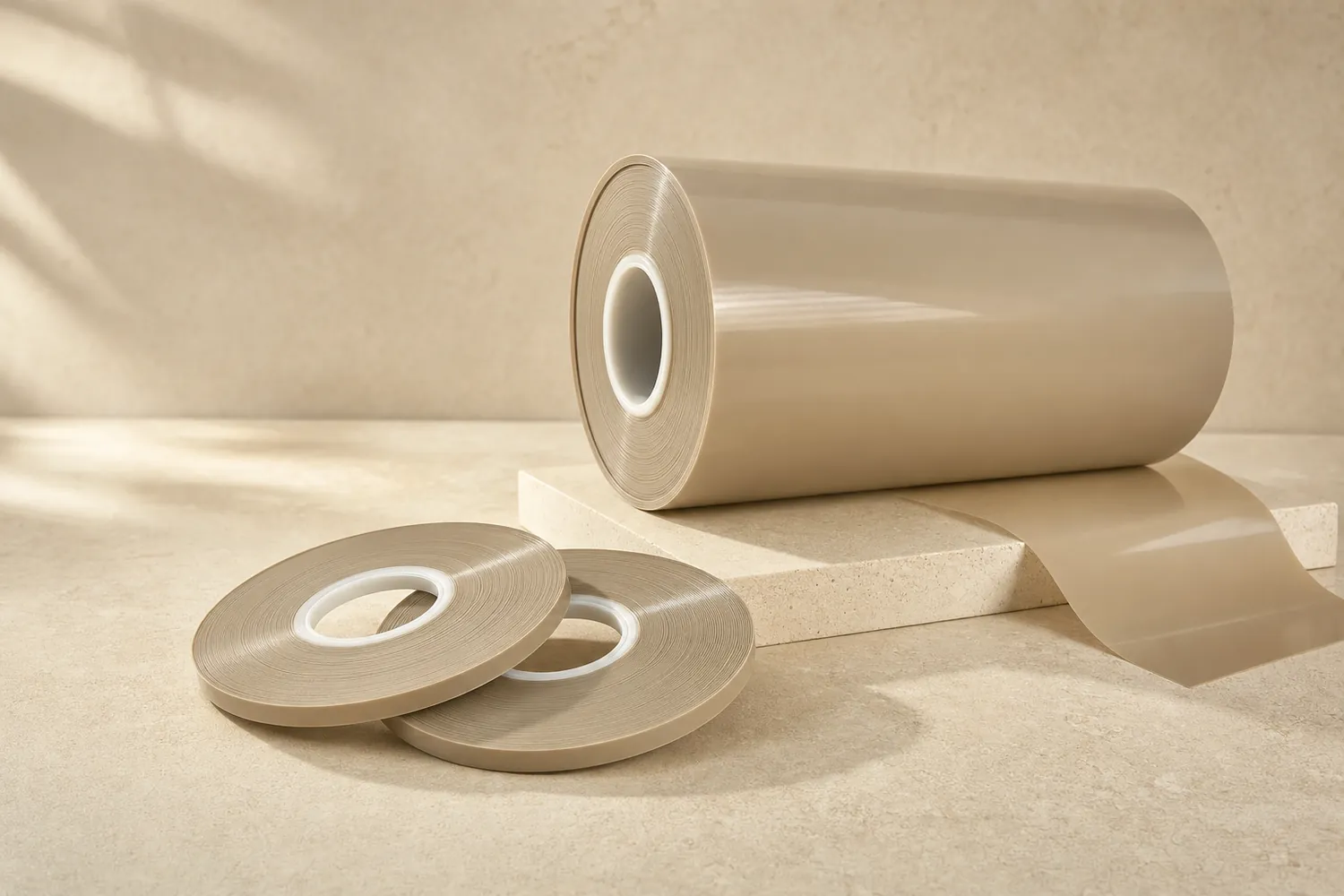
PEEK Film Specifications Explained: Thickness, Width, Temperature and Biocompatibility
Quick answer: PEEK film is a semi-crystalline high-performance thermoplastic supplied as thin sheet. The four numbers that decide whether a grade suits your application are thickness (0.02–0.8 mm), usable width (5–1500 mm), continuous service temperature (260 °C, with 300 °C short-term excursions), and biocompatibility compliance (ISO 10993). Thickness controls dielectric strength and flexibility; width controls how much scrap you generate in conversion; temperature controls creep and dimensional stability; biocompatibility controls whether the part can touch tissue or food.
A specification sheet for PEEK film looks short. Six or seven lines, most of them numeric, none of them explaining what changes when you move a decimal point. That brevity is deceptive: each parameter is a design constraint that propagates through the whole downstream process — how the film is die-cut, how it behaves in a lamination press, whether a connector insulates reliably at operating temperature, and whether a finished device clears regulatory review.
This guide walks through the parameters in the order they typically bind, and explains the trade-off each one carries. It is written for engineers and sourcing teams specifying film for electrical, aerospace, semiconductor, medical or general industrial use.
1. Thickness: the parameter that sets everything else
PEEK film is commonly produced in the range of 0.02 mm to 0.8 mm, with intermediate gauges available on request. Thickness is not simply a size choice — it drives four properties at once.
| Thickness band | Typical use | What it gives you | What it costs you |
|---|---|---|---|
| 0.02 – 0.10 mm | Speaker and diaphragm membranes, capacitor and motor insulation, thin-film shims | High flexibility, low mass, good conformability, high dielectric strength per unit volume | Harder to handle without wrinkling; creasing is permanent; tight tolerance needed on cutting |
| 0.10 – 0.30 mm | Electrical insulation washers, semiconductor handling fixtures, printer and copier components | Balance of stiffness and formability; good puncture resistance | May need pre-heating to form tight radii |
| 0.30 – 0.80 mm | Structural shims, wear pads, brush holders, aerospace brackets and spacers | Load-bearing capacity, dimensional stability, machinable and drillable | Stiff — not suited to conformal wrapping; higher cost per part |
A useful rule of thumb for weight and material planning: a 0.1 mm PEEK film weighs approximately 1.3 g per cm² of build volume at the density of unfilled PEEK (~1.30 g/cm³). This figure matters when film mass affects the inertia of a moving assembly, or when you are calculating how many square metres a kilogram of film will yield.
2. Width: why 5 mm minimum matters more than 1500 mm maximum
Suppliers advertise the maximum width — up to 1500 mm — because it signals production capability. Buyers should pay closer attention to the minimum width of 5 mm and the availability of custom slitting, because these determine your conversion yield.
Wide rolls are convenient if your finished part is a large panel. If your finished part is a 12 mm-wide insulating strip, buying a 1500 mm master roll and slitting it in-house means you are paying for edge trim, handling the full roll weight, and managing slitting equipment. Buying pre-slit 12 mm tape converts a manufacturing step into a purchased input.
Three questions resolve the width decision quickly:
- What is the narrowest finished dimension? If it is under 20 mm, ask about pre-slitting and about slit-edge quality — a rough slit edge on thin film creates a crack-initiation site under flexing.
- How will the film be fed? Roll-to-roll converting equipment tolerates width variation better than sheet-fed press equipment, which requires flat, stress-relieved sheets.
- What is the grain direction? Biaxially stretched film has more balanced properties in the machine and transverse directions than uniaxially oriented film. Parts that flex repeatedly should be oriented so that the primary stress axis aligns with the more favourable direction.
3. Temperature: 260 °C continuous, 300 °C short-term — and what "short-term" means
PEEK film carries a long-term service temperature of 260 °C and tolerates short-term excursions to 300 °C. The distinction is not marketing language; it reflects two different failure mechanisms.
| Regime | Temperature | What happens | Design implication |
|---|---|---|---|
| Continuous service | up to 260 °C | Mechanical properties remain stable over thousands of hours; creep is predictable and low | Use this figure for load-bearing and dimensional-tolerance calculations |
| Short-term excursion | up to 300 °C | No melting or degradation, but the material softens — modulus drops and creep accelerates | Safe for soldering, curing, sterilisation and thermal cycling, provided the part is not under sustained load |
| Melting | ~343 °C | Phase change | Thermal processing ceiling; relevant for hot-press and lamination cycles |
The practical error to avoid is designing a load-bearing part against the 300 °C figure. A clamp, spacer or fixture that must hold a tolerance at temperature should be specified against 260 °C, with a design margin. Reserve the 300 °C figure for processes that are inherently brief — a reflow pass, a sterilisation cycle, a curing bake — where the material must survive without deforming under its own weight.
PEEK's position in the high-temperature family is best understood by comparison. It sits above standard engineering thermoplastics such as polyamide and acetal, and above most fluoropolymers in mechanical strength, while PTFE retains better chemical inertness at the extreme end. Where a part needs both high temperature and structural capability, PEEK is usually the shorter list.
4. Biocompatibility: ISO 10993 and what the certificate actually covers
PEEK film is supplied with biocompatibility testing consistent with ISO 10993, the standard series governing biological evaluation of medical devices. This is a meaningful qualification, but it is frequently over-read.
Two clarifications prevent expensive misunderstandings:
- ISO 10993 compliance applies to the material, not to your finished device. A device-level submission still requires its own evaluation, including consideration of the manufacturing processes, cleaning agents, adhesives and any additives introduced after film production.
- Check which parts of the series were tested. The 10993 series covers cytotoxicity, sensitisation, irritation, systemic toxicity, implantation effects and more. A supplier's certificate should state which tests were performed on which grade and thickness.
Beyond medical use, the same inertness profile makes PEEK film suitable for food-contact and for semiconductor environments where outgassing and particle generation are controlled. Note that unfilled PEEK and PEEK filled with certain additives (carbon fibre, glass, graphite, or bearing-grade PTFE) have different property sets and often different approvals. Specifying "PEEK film" without naming the grade is the single most common source of a rejected first article.
5. Chemical resistance and dimensional behaviour
PEEK film resists attack by most acids, bases and organic solvents, which is why it is used in semiconductor wet benches and chemical processing equipment. The notable exceptions are concentrated sulphuric acid, some halogenated compounds, and certain strong oxidising agents at elevated temperature. Always confirm the specific chemistry against a compatibility table rather than assuming "PEEK handles everything".
PEEK is also hydrolysis-resistant — it does not degrade in boiling water or steam, which is a key advantage over polyimide and polyester films in sterilisation and humid environments.
For dimensional work, keep in mind that PEEK is hygroscopic to a small degree. Parts machined to tight tolerance should be conditioned in the intended service environment before final measurement. Storage should be in a dry, dark location between 10 °C and 30 °C, away from direct sunlight.
6. A specification checklist
Before releasing a PEEK film specification, confirm each line has an answer:
- Thickness, with tolerance — and whether the tolerance is on the gauge or on the finished part
- Width, plus slit tolerance and edge condition if pre-slit
- Grade — unfilled or filled, and if filled, with what
- Colour and opacity requirement
- Continuous and peak operating temperature, with duration for the peak
- Whether the application is load-bearing at temperature
- Required compliance documents — ISO 10993 series parts, food contact, semiconductor cleanliness
- Chemical exposure list, including cleaning agents
- Surface treatment requirement, if the film will be bonded, printed or metallised
- Delivery format — roll core diameter, sheet size, interleaving, packaging
What is the thinnest PEEK film available?
Production grades commonly start at 0.02 mm. Below that, handling becomes difficult and the film is easily creased, so very thin gauges are usually quoted as a special order with defined handling requirements.
Can PEEK film be used at 300 °C continuously?
No. 300 °C is a short-term excursion limit. Continuous service should be designed against 260 °C. At 300 °C the material softens and creep accelerates, so parts under sustained load will lose tolerance.
Is PEEK film biocompatible?
PEEK film is supplied with ISO 10993-consistent testing. That qualifies the material, not your finished device — device-level biological evaluation remains the manufacturer's responsibility, and you should confirm which tests in the series were performed on the specific grade you are buying.
What is the maximum width of PEEK film?
Up to 1500 mm. Minimum width is 5 mm, and custom slitting to intermediate widths is available, which is usually the more cost-effective route for narrow finished parts.
Does PEEK film resist steam sterilisation?
Yes. PEEK is hydrolysis-resistant and does not degrade in boiling water or steam, unlike polyimide and polyester films. This makes it suitable for repeated autoclave cycles.
Specifying PEEK film for a specific application? Guangzhou Furui New Material Technology Co., Ltd produces PEEK and PEI film from 0.02 mm to 0.8 mm, in widths from 5 mm to 1500 mm, with custom slitting and ISO 10993-consistent biocompatibility documentation. Send us your thickness, width and temperature envelope with your intended application and we will confirm the grade and provide samples for evaluation.